 IPNL — Intelligent Positioning and Navigation Laboratory
Research: Trustworthy PNT from Signal to State
IPNL builds trustworthy positioning, navigation, and timing systems from receiver-level GNSS signal processing to integrity-aware autonomy. We study the full PNT chain — receiver-level signal processing, urban signal degradation, 3D environmental awareness, factor graph optimization, multi-sensor fusion, and integrity monitoring — so that robots, vehicles, drones, smartphones, and safety-critical systems know not only where they are, but also whether their position can be trusted.
Our lifelong technical mission is robust, low-cost sensor fusion for embodied intelligence — drones, ground vehicles, and the next generation of mobile robots — using a set of local sensors and seamless operation across open-sky, urban canyon, indoor, and GNSS-denied environments.
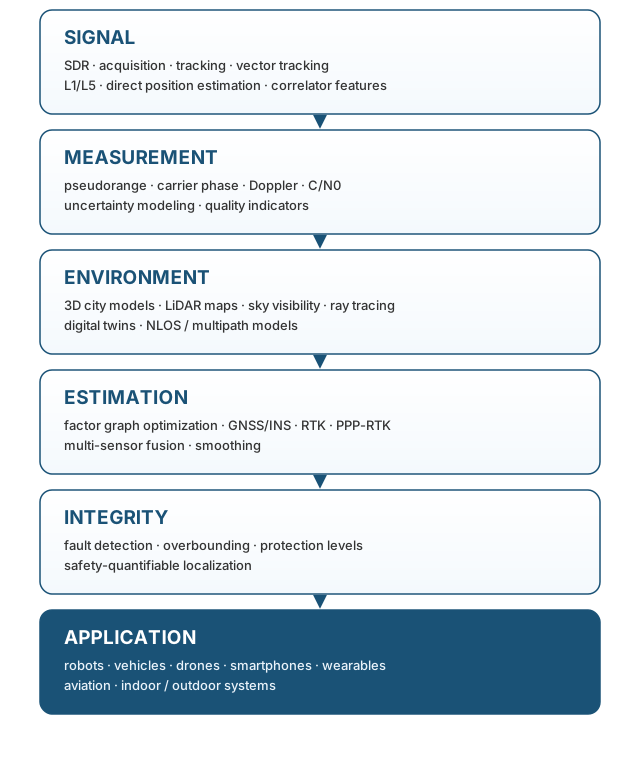
The IPNL PNT stack
We own the complete signal-to-application chain — from raw GNSS signal processing up to integrity-aware autonomy:
Recognition
- 2023 ION Per Enge Early Achievement Award — single-awardee per year, second-ever Asian-university recipient
- 2024 Most-Cited Paper in NAVIGATION: Journal of the Institute of Navigation — Factor Graph Optimization for GNSS/INS Integration: A Comparison with the Extended Kalman Filter (Wen, Pfeifer, Bai, Hsu)
- General Chair, IPIN 2024 (Indoor Positioning and Indoor Navigation Conference, Hong Kong; 300+ delegates)
- Founding Chair, ION/IAG Working Group on Positioning and Navigation at Asian Urban Canyons (since 2019)
- Associate Editor, NAVIGATION: Journal of the Institute of Navigation (since 2022); IEEE Transactions on Aerospace and Electronic Systems (since 2024)
Research pillars
Receiver-Level GNSS Signal Processing and SDR
Software-defined receivers, vector tracking, and signal-quality analysis that turn distorted satellite signals into usable measurements with explicit uncertainty.
Urban GNSS Reliability and Signal Error Modeling
Modeling how GNSS measurements fail in dense cities — NLOS, multipath, diffraction, heavy-tailed errors — so downstream estimation and integrity systems know when to trust them.
Environment-Aware and 3D Map-Aided PNT
Using 3D city models, LiDAR maps, sky visibility, ray tracing, and digital twins to turn the urban environment from an obstacle into prior information for navigation.
Optimization-Based Estimation and Factor Graphs
Factor graph optimization as a unifying framework for GNSS, INS, carrier phase, Doppler, maps, perception, and integrity — reasoning over time across heterogeneous measurements.
Integrity, Fault Detection, and Safety-Quantifiable Localization
Navigation systems that estimate both state and trust — fault detection, non-Gaussian overbounding, protection-level computation, and integrity-constrained optimization for safety-critical autonomy.
Seamless Multi-Sensor PNT for Embodied Systems
Tightly coupled GNSS/INS/LiDAR/camera/UWB/Wi-Fi fusion for vehicles, robots, drones, smartphones, and wearables operating across open-sky, urban canyon, indoor, and GNSS-denied conditions.